Chapter IV 4/9
The First Cursillo in Christianity in History
Cala Figuera de Santanyí, 1944, and the first steps of an experience called to bear fruit.
Share chapter
From the beginning, the great desire of Eduardo Bonnín and of those who began this journey with him was to foster a true encounter between the inner freedom of the human person and the transforming action of the Spirit of God.
Everything revolved around this deep conviction, and the group was certain that success would depend on the ability to create a favourable environment in which that encounter could take place with authenticity and depth.
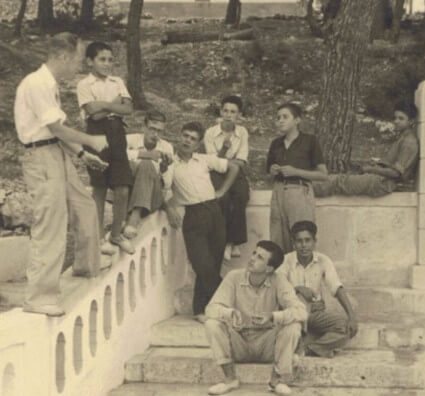
It was with this vision that, in August 1944, the first Cursillo was held in a chalet located in Cala Figuera de Santanyí, with the participation of fourteen men. The outline used in that encounter has remained practically intact to this day, with the exception of two contents — the first and the last rollo — which would only be formally integrated into the method during the 1950s.
One striking element introduced by Eduardo in that first retreat was the celebration of the Way of the Cross, according to a text by Father Llanos, which took place right at the beginning of the encounter, serving as a spiritual opening and inner preparation.
However, Bonnín did not have an easy path in seeing his method accepted. One of the greatest sources of resistance arose from his insistence on proposing the same cursillo for participants from very different social, cultural and spiritual backgrounds.
While some argued that it would be better to divide the groups according to their level of formation or religiosity, Eduardo firmly believed in the value of diversity, considering this approach non-negotiable. His experience during military service, in a genuinely cross-class environment, had shown him that the strength of the Christian message surpasses every human barrier.
What we know as the first Cursillo de Cristiandad in history, as structured by Eduardo, took place from 19 to 23 August 1944, in the chalet of Cala Figuera, in Mallorca.
In that inaugural encounter, the Spiritual Director was Rev. Fr Juan Juliá, while Eduardo Bonnín took on the role of rector. The formation team was composed of Jaime Riutort and José Ferragut.
There were fourteen participants: Sebastián Mestre, Antonio Binimelis, Leopoldo Febrer, Bartolomé Obrador, Francisco Oliver, Salvador Escribano, Damián Bover, Antonio Mesquida, Francisco Estarellas, Antonio Obrador, Antonio Mas, and three who, at the time of the testimony, were still alive: Miguel Rigo, Onofre Arbona and Francisco Grimalt.
This cursillo was initially presented under the name “Fifth Cursillo for Pilgrim Leaders”, but what was lived there surpassed all expectations. The fruits of personal conversion and the transformation of environments through the lived experience of the participants confirmed that something new had been born there.
Even so, many members of diocesan Catholic Action saw it merely as another shorter version of a cursillo for leaders, with a few adaptations typical of “Eduardo’s things” — but which, surprisingly, proved more effective than the models coming from Madrid. For that reason, many understood that it was worth repeating.
Despite its practical acceptance, the debate about the structure of the groups continued. Should cursillos be organised according to the degree of faith or the cultural level of the participants?
For Bonnín, the answer was clear and non-negotiable: no. He believed that the message of Christ must reach the heart of the person as he is, wherever he may be, and that this openness to diversity is precisely what gave the movement its unique character.
“The encounter with Christ takes place in the inner silence of the person.
That is why we have always sought to ‘reach from the surface to the very depths of one’s being’.”
“This is the novelty of the Cursillo — what makes it different from so many other initiatives. However good they may be, they are not the same, nor do they achieve the same. This is the genuine mark of our method: it was through it that the message of Christ was able to reach so many who were far away — through ignorance, through lack of information, or even through misinformation.”
“What we know today as the Cursillos de Cristiandad was born through the hands of lay people.
The idea, the purpose, the structure and even the arrangement of the rollos were conceived solely by lay people committed to the faith.
When we brought the proposal to the hierarchy, we handed everything over: rollos, notes, annotations.
And we asked, on our own initiative, that some priests be appointed to accompany us — not by imposition, but out of a desire for communion.
Thanks to the wisdom, understanding and freedom with which those priests accompanied us, the movement had a happy childhood, with room to grow and deepen, even as it broke — and continues to break — many of the traditional patterns of pastoral ministry.”