Chapter I 1/9
Eduardo Bonnín, Founder and Foundation
The person, intuition and central role of Eduardo Bonnín in the origins of the MCC.
Share chapter
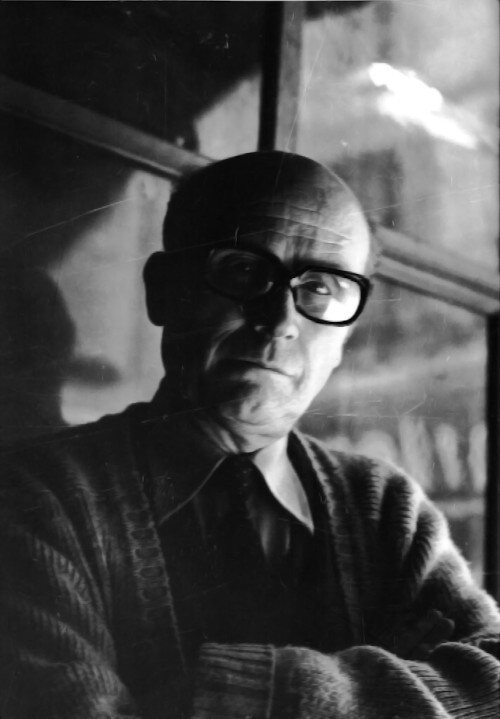
Eduardo Bonnín Aguiló was born on 4 May 1917 in Palma de Mallorca, Spain, in the family home located in the heart of Plaza de España. He grew up in a Catholic household deeply connected with trade and the semi-wholesale export of cereals and dried fruits.
He was the second of ten siblings, born of the marriage of Don Fernando Bonnín Piña and Doña Mercedes Aguiló Forteza.
His early education took place at the French School and at La Salle College. Later, he deepened his studies with the Augustinian Fathers, complementing this formation with private lessons given by teachers hired by his parents, who placed great value on education within the family environment.
Eduardo often said that his grandfather Jorge was the first true teacher of his life, for it was he who awakened in him a love of reading. He considered that “nothing influenced my life as much as my stubborn and ever-growing interest in reading”.
In 1936, while carrying out his compulsory military service, he lived through an experience that marked him profoundly. It was there that his contact with the real lives of the men in the battalion and the idealistic world he encountered in books converged in his own life, opening up new horizons of reflection.
At that time, by a coincidence that many would call providential, a speech by Pope Pius XII came into his hands. It had been delivered on 6 February 1940, in Rome, before parish priests and Lenten preachers. In it, the Holy Father appealed for the search for “new” paths, different from the traditional ones, in order to bring the Love of God to all, with particular attention to those furthest away.
Inspired by this challenge, Eduardo began to outline his own scheme of reflection, which he would later call the “Study of the Environment”.
From this foundation, the three essential pillars of his vision took shape: Christ, friendship and the human person, with a very special affection for those who were most distant from the faith.
Although he was not yet part of the structures of Catholic Action, he was invited to take part in the first Cursillo for Advanced Pilgrim Leaders, intended to awaken in young people the desire to make a pilgrimage to Santiago de Compostela. However, he declined the invitation, as he did not identify with the style and attitudes of the participants.
Later, it was José Ferragut who encouraged him to take part in the second Cursillo for Advanced Pilgrim Leaders, held in 1943 at the Sanctuary of Lluch. This time, the lighter, more joyful and spontaneous atmosphere among the young people appealed to him. Even so, Eduardo realised that the preparation should not be limited to the pilgrimage itself, but should prepare young people for life itself.
The decisive point in the emergence of the Cursillo Movement took place shortly after Holy Week in 1943. Eduardo began to relate the experience he had lived during that cursillo to his deepest longings and to the reality of dechristianised environments. It was then that he glimpsed that a method similar to the one he had experienced, but with its own distinctive features, could revitalise not only occasional events — such as the pilgrimage to Santiago — but also the everyday life of any social environment.
That same year, 1943, he publicly presented his “Study of the Environment” for the first time, during a session at the Diocesan Seminary of Mallorca.
On the basis of this vision, and inspired by the experience gained in the cursillo for pilgrim leaders, Eduardo conceived an integral method that would make it possible to leaven the Christian faith both in people and environments distant from it, and to deepen the lived experience of those who were already close to it.
A particularly significant moment occurred in 1944, when, at the invitation of Rev. Fr Sebastián Gayá, he took part in a session of the School of Propagandists, led by this priest. There, Eduardo presented the outline he had developed as the final stage of his method — the one that would later become known as the rollo “The Cursillista Beyond the Cursillo”.
It was also in that same year that the first Cursillo structured according to Eduardo’s method was held, from 19 to 23 August 1944, in a summer house — a chalet — located in Cala Figuera de Santanyí, on the island of Mallorca.
The first Cursillo de Cristiandad in history had the spiritual guidance of Rev. Fr Juan Juliá. In this pioneering encounter, the role of rector was carried out by Eduardo Bonnín, and the contents were presented by Jaime Riutort and José Ferragut, who served as formators.
This cursillo already included all the essential elements that we recognise today in the method, with the sole exception of the first and last talks, which would only take their definitive form during the 1950s.
Eduardo never had any doubts about the authenticity of that first encounter. He often stated that, from then on, he used the same original outlines and documents in all subsequent cursillos, as a way of bearing witness to the continuity and integrity of that initial model.
The second Cursillo de Cristiandad was held in September 1946 at the Sanctuary of San Salvador, in Felanitx, also in the south of Mallorca. Rev. Fr Juan Juliá once again took on the spiritual direction, Eduardo Bonnín remained as rector, and the contents were led by António Ruíz and Guillermo Estarellas, both young leaders connected with Catholic Action.
This second cursillo also marked an important step in the relationship with the local Church: the Diocesan Chaplain, Mr Dameto, was present at the closing session, in a symbolic gesture that represented the first official support of the Diocese of Mallorca for the new movement.
The third cursillo took place from 16 to 20 April 1947, with Fr José Estelrich as spiritual director, Eduardo Bonnín once again as rector, and José Seguí as the only formator present.
In 1948, two further cursillos took place, both using the same method. The first was held during Holy Week, with the spiritual retreat led by Father Amengual and the spiritual guidance entrusted to Father Bartolomé Nicolau. José Ferragut served as rector, and among the formators were Eduardo Bonnín, Bartolomé Riutort and Juan Mir.
The second took place in April and had its spiritual direction shared between Fr José Estelrich and Fr Miquel Sastre. Eduardo Bonnín once again took on the role of rector, with Onofre Arbona and António Salvá as formators.
Although the movement had already been under way since 1944, it was only from the cursillo held on 7 January 1949, at the hermitage of San Honorato, that an official numbering of the Cursillos de Cristiandad began. This came to be regarded as “Cursillo No. 1”, with Rev. Fr Guillermo Payeras as Spiritual Director and, once again, Eduardo Bonnín as rector.
The rapid growth of the movement in 1949 led Eduardo to a deeper reflection: he feared that the increase in participants might compromise what he considered to be the heart of the post-cursillo — the friendship groups. From this reflection there quickly emerged the structured proposal of the “group reunion”, as a way of giving continuity, in community, to the journey begun in the cursillo.
This intuition was strengthened and made official during the Annual Assembly of 1949, held in November, where a paper dedicated to the theme of Groups was presented, thereby institutionalising the weekly group reunion as an essential part of the cursillista method.
Over the years, the seed of the Cursillos was sown in the most diverse corners of the world — and Eduardo Bonnín closely accompanied that growth, visiting and encouraging communities where faith was beginning to ferment.
With his customary humour, he used to say: “I do not have a kilometre counter on my feet”, a gentle way of downplaying his international missionary itinerary and avoiding praise for having proclaimed the Gospel in so many places.
Among his many destinations, it is known that he was in China three times. In 1966, he travelled to Brazil, New York and Peru. The following year, in 1967, he visited Bolivia, Costa Rica and Miami, and took part in the Third National Leaders’ Gathering in Guadalajara. On 4 May 1968, he was present at the Ultreya of Fátima.
In 1998, after a decade without returning, he went back to Chile, passing through Tuvulú, Santiago, Valparaíso and Temuco. That same year, he also travelled to Bolivia, Guatemala and Mexico, and visited the Italian cities of Ravenna and Padua.
Today, there are clear records of the movement’s presence on all five continents — a living sign of the impact that this seed has had and continues to have.
Eduardo lived his entire life dedicated to God and to the service of people, always with a joyful spirit, yet never complacent — as he himself used to say, “always joyful, but never complacent”.
On 6 February 2008, he departed for the Father’s House. He was buried in the Church of the Capuchins, and on his tomb rests the phrase by which he defined himself:
“An Apprentice Christian.”